

HOW COUPLES WITH DIFFERENT RELIGIONS CELEBRATE THE HOLIDAYS
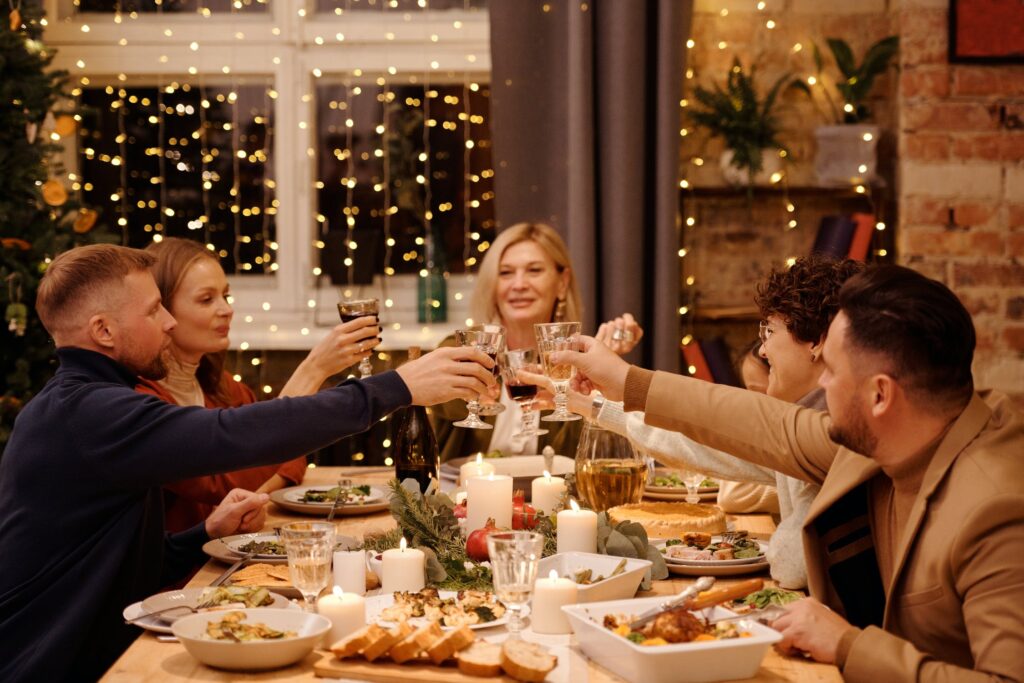
Twas the Night Before Christmas
by Clement Clarke Moore
‘Twas the night before Christmas, when all through the house.
Not a creature was stirring, not even a mouse;
The stockings were hung by the chimney with care,
In hopes that St. Nicholas soon would be there;
The children were nestled all snug in their beds,
While visions of sugar-plums danced in their heads;
And mamma in her ‘kerchief, and I in my cap,
Had just settled down for a long winter’s nap,
Blessings for Chanukah
by Jessie E. Sampter
Blessed art thou, O God our Lord,
Who made us holy with his word,
And told us on this feast of light
To light one candle more each night.
Because when foes about us pressed
To crush us all with death or shame,
The Lord his priests with courage blest
To strike and give his people rest
And in the House that he loved best
Relight our everlasting flame.
Did you ever wonder the coincidence of how some of the most religious holidays of Christians and Jews fall out juxtaposition to one another? Easter parallels with Passover and Christmas with Chanukah—both about death and joy! Ponder that! To understand the difference between Christmas and Hanukkah, it is important to know the history and significance of each holiday. Centuries separate them. Historically there is no similarity except in dedication in God as one knows God and both have become exceedingly commercialized. The Talmud, the central text of Rabbinic Judaism and the primary source of Jewish religious law and Jewish theology ( Wikipedia), relates the story that when the Jews entered the temple and wanted to light the Menorah (the seven-branched candelabra), no oil was ritually fit for the Menorah. Finally, however, they found a small jar of ritually pure oil, just enough for one day. However, a miracle occurred: the Menorah burnt for eight days on this small amount. And this was long enough to produce new pure oil, rendering Hanukkah, the Miracle of Lights.
Dedication
The word Hanukkah, or Chanukah means dedication. Hanukkah is not just about lighting candles. It is about dedicating and rededicating oneself to a life by God’s Word. It is a Jewish thought that every human being is supposed to make of himself a temple, a sanctuary by learning the values of God’s Word. In this way, he spreads light into the world. That is how Israel understands her own being in the world. *Kees de VreugdKees de Vreugd studied Theology in Utrecht and Jerusalem. He was based in Jerusalem for three years as representative for Israel International.
For Christians, the true meaning of Christmas is the celebration of the birth of the savior, Jesus Christ. Christianity knows that through belief in Christ they are daughters and sons of God. Heaven will one day be their home. Jesus was born in order to pay the price for the things we have done wrong: sin. God sent his only son to be the atonement for all our sins so that we would not be separated from God. Without Jesus, we would all die for our sins. We inherited our sinful nature from the first human beings God created, Adam and Eve. While being fully God and yet fully man, Jesus came into the world as an infant to save us all. The date of birth of Jesus of Nazareth is not stated in the gospels or in any secular text, but most scholars assume a date of birth between 6 BC and 4 BC.
*Heather Riggleman
Wow! Let’s Do Both!
Celebrating the holidays with couples of different religious beliefs can be a unique and a double pleasure experience. Since the holidays arrive close together, usually in the month of December, it can be a joyous time for both partners who maintain their respective religious beliefs. Often both are celebrated. The children benefit the most, as they receive eight gifts, one for each night of Hanukkah and sometimes twelve for Christmas, for the twelve days of Christmas. The 12 days of Christmas is the period in Christian theology that marks the span between the birth of Christ and the coming of the Magi, the three wise men. It begins on December 25 (Christmas) and runs through January 6 (the Epiphany, sometimes also called Three Kings’ Day). That totals twenty presents for each in all. That can be a joy for the kids and stores, but a liability and stressor for the parents. Joy to the world is more for the manufacturers, distributors and retailers than the Lord has come!
In families where a decision has been made to raise the children of the faith of one partner as opposed to both religions, this doesn’t usually present an issue as this has already been agreed upon prior to the marriage. As not to confuse the children, one holiday is celebrated as opposed to both. Due to the fact that both holidays have become more of a secular rather than a religious holiday, many families celebrate both, lighting Hanukkah candles while placing presents under the tree. There really is no right or wrong as long as the partners are harmonious and in agreement. However, this is idyllic—not necessarily realistic!
The truth: It’s Never About the Holidays
Holiday blues and discord are not necessarily about the holidays or religion. More often It’s about something else that gets expressed in holiday season. Too often it triggers memories of past holidays that were ruined because of dysfunctional family systems. It’s best to understand the cause of distress during these times. The holidays can be a joy for many but a heartache for others. Unresolved conflicts from the past emerge during the season to be jolly causing depression and anxiety resulting in mood shifts, anger and loneliness. As many look forward to bringing in the yuletide, others can’t wait for it to pass. The hardships caused by over spending, especially during these challenging times, leave many with fears of the consequences. Fears become translated into anger that get displaced onto our partners. Religious differences are not the enemy. It’s usually a childhood wound that takes over and disrupts holiday season. Holiday blues are not uncommon as they are reminders of the past; not the present or religious differences. Arguing over opening the presents Xmas Eve verses Christmas day is never the issue. Saving the wrapping paper or throwing it away is not the culprit either. It’s about something much deeper; much more painful. These unresolved childhood wounds get acted out during holiday season for many reasons other than religious differences. You can trust there will be trouble in homes if alcohol or drugs play a part. Partners who are active in substance abuse can cause havoc on the family during the holidays.
So, when your honey sulks, or becomes aggressive, withdrawn, critical, judgmental, contemptuous or just plain cranky, know that it’s not about you—nor about your religious differences—nor about the miracle of lights or the Christmas spirit. It’s about the gunnysack he or she has been carrying since childhood, filled with repressed hurt, grief, anger, unresolved traumas, fear and more. Give the gunnysack to Santa to carry up the chimney as he says,” Merry Christmas to all and to all a good night!” The spirit of both holidays is for peace and good will. With that in mind, sharing holiday traditions can be an enrichment for the entire family.
“God is not dead, nor doth He sleep; The Wrong shall fail, The Right prevail, With peace on earth, good-will to men.”
*Henry Wadsworth Longfellow (1863)
Joan E Childs, LCSW is a renowned psychotherapist, inspirational speaker and author of Do You Hate the One You Love: Strategies For Healing and Saving Your Relationship. In private practice since 1978, she specializes in individual and couple’s therapy, grief therapy, EMDR, NLP, Inner Child Work and codependency. Learn more about her services at www.joanechilds.com.
Share this article
Follow us
A quick overview of the topics covered in this article.
Latest articles
October 10, 2026
October 10, 2026

October 10, 2026