
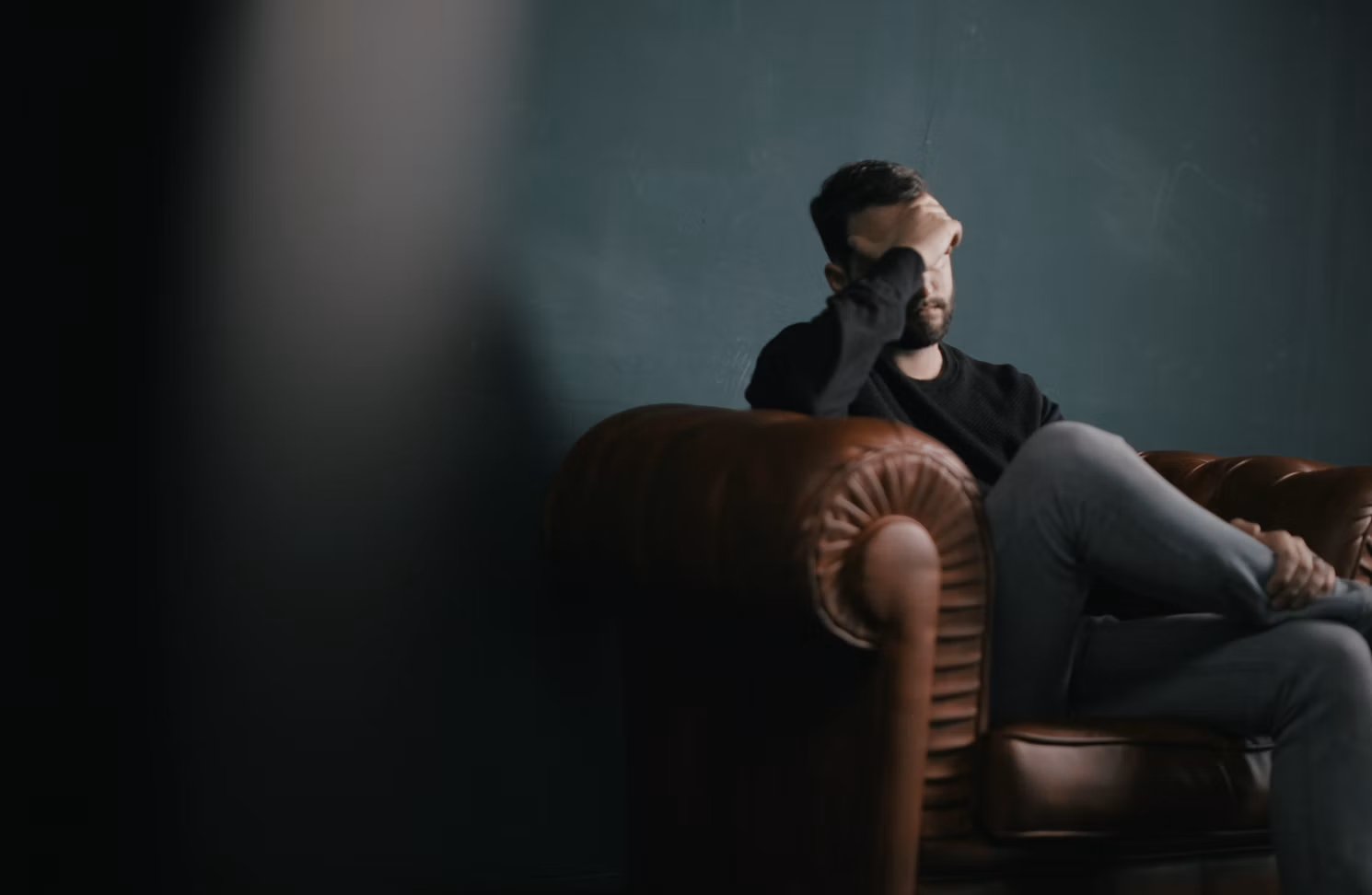
How Losing a Partner Can Change Your Relationship With Yourself?
King Theoden from The Lord of the Rings famously said, “No parent should have to bury their child.” The same holds for anyone who has to see the death of their partner. It’s a grief beyond words and often potent enough to change the course of one’s life, permanently. This is something that’s well researched.
When a partner dies, the widowed individual’s risk of depression increases by 20% in the first two years. It is only after three years that symptoms and risk return to baseline levels. Interestingly, men between the ages of 50 and 59 showed the strongest impact, with up to 4 extra symptoms.
The reality is that three years to get over the passing of your loved one can go by either quickly or excruciatingly slowly. What you’ll certainly notice is how the loss changes the way you live your life and the way you relate to yourself. Let’s explore this theme in more detail below.
You May Return to Pre-Relationship Identities
Relationships often cause people to make major life decisions. For some, it causes them to leave their hometowns and start a life in a new state or even country. For others, it might mean leaving a job to make things work logistically in your new life. After the loss of a partner, you might start to feel a pull toward those old identities.
So, if you used to be a nurse but your partner felt like the long hours were bad for the relationship, quitting made sense. Your partner might have earned enough that giving up the career didn’t affect finances too much. Now, without them, you might feel an urge to get back into the fray.
People in this type of situation might want to pursue upskilling. An online Master of Science in Nursing FNP program may be a sensible option for a nursing professional with a bachelor’s degree. If you stayed at home all this while, the online nature of such courses makes it easier to get back into a more action-filled life again.
As Texas Woman’s University explains, these courses only take about two years when attended full time. Time passes quickly, and before you know it, you’re just one year away from the supposed grief-recovery threshold. If you feel like entering the workforce might make things worse for your recovery, you’d be surprised.
One study focused on 68 in-depth interviews with employees who had experienced bereavement or a breakup. The paper shows that job crafting, the act of reshaping work to fit your circumstances, can be a great coping mechanism. Some employees increased their workload to distract themselves, while others reduced responsibilities to conserve emotional energy.
You May Have To Rebuild Your Sense of Connection
After the loss of someone you love dearly, it’s common to feel like a part of yourself has become fractured. You may even feel like this fracture can never heal and that no amount of therapy can help. That’s partly true. There are some aspects of this wound that may never fully heal, with loneliness being a good example.
A study on over 5,500 people in Germany found that parenthood did not significantly reduce loneliness after widowhood. This was even when widowed parents had close relationships with adult children. According to Professor Matthias Pollmann-Schult, co-author of the paper, the impact of spousal loss is too profound to be substantially mitigated, even with strong social support from children.
As such, you may find yourself realizing that finding connection has gotten harder. In many cases, countering that difficulty requires effort and activities that a widowed person might have no interest in. Isolating feels much more comfortable and tempting, but it’s a path that’s not easy to leave.
So, while a part of you feels like it died with your partner, you have to remember that you are still in this world. Your body and mind have physical, emotional, and psychological needs that need to keep being met. So, no matter how hard it feels to start talking to people again or make new friends, it’s something you need to work toward.
You Begin To Live a Double Life
“There’s a time and a place for everything,” or so the world will tell you. “It’s alright to mourn your loss, but not for too long.” These are the unspoken sentiments you might pick up on if you’re perceptive. But what if you can’t heal that quickly? Your friends and family have gotten over the shock, and your colleagues and people at work may no longer check up on you. Yet, you haven’t recovered yet.
They expect you to move on… and so you do. At least you act like it. You put on a mask for everyone else. You smile at people, laugh at their jokes, and work hard on your responsibilities. You play the role of someone who has ‘healed.’ Yet, this isn’t the real you. In secret, you might be dealing with grief attacks every day or every week.
The double life can be exhausting, which is why you’ll have to make the decision early about how you’ll handle society’s expectations. Something that can help is having a few reliable people you can be your genuine self with. That way, the mask you wear isn’t so absolute.
Likewise, remove the idea of “should” from your vocabulary. Your functional persona is a survival tool you have created. So, if you find yourself lacking the energy to live up to the standards of society, don’t let it get to you. Rather, explicitly permit yourself to do things on your own time. If there’s ever a time when it’s justifiable to be selfish, this is it.
Frequently Asked Questions
Why do I feel guilty when I start enjoying life again after my partner dies?
Feeling happy again can sometimes feel like you’re leaving your partner behind, especially when the loss is still fresh. You may wonder whether enjoying yourself means you are grieving less. Remember that moments of happiness do not diminish your love or erase the life you shared.
How do you adjust to living alone after losing a spouse?
Give yourself time to get used to the practical and emotional changes of living alone. Creating simple routines, staying connected with people you trust, and gradually making your own plans can help. You don’t have to immediately feel comfortable with your new circumstances.
Is it normal to lose friends after your partner dies?
Yes, friendships can change after a partner dies. Some people may feel unsure about what to say or struggle to understand what you’re experiencing, while others may simply drift away as life changes. Although painful, this can also reveal which relationships provide genuine support during difficult periods.
Key Numbers & Facts at a Glance
| Increase in depression risk after partner loss | 20% |
| Time for depression risk/symptoms to return to baseline | 3 years |
| Demographic most affected by partner loss | Men aged 50 to 59 |
| Influence of supportive children | No significant reduction in loneliness experienced |
Losing a partner is certainly going to be one of the hardest experiences one has in life. Even when people pass naturally, from old age, it still comes as a massive shock to the one left behind. It goes without saying that people who lose their partners before their time have it even harder. They might have had an entire life planned out together before that possibility was ripped away from them.
Ultimately, the main comfort that the widowed one can take heart in is that time, in its own way, does heal all wounds. Similarly, it can be heartening to know that you are not alone in this experience. Death, from the beginning of time, has taken loved ones away from each other. Yet, countless billions of humans have found ways to cope and move on in each generation. Take heart that you too are one among them, with the same potential to heal.
Share this article
Follow us
A quick overview of the topics covered in this article.
Latest articles

October 12, 2026
October 12, 2026

October 12, 2026